Engineering a Panel of Potent and Developable Anti-CD3 Antibodies for Conditional Activation in the Tumor Microenvironment

September 19, 2025
Reading time - 2 minutes

Adimab scientists developed a novel panel of anti-CD3 IgGs with a tumor microenvironment (TME) protease-cleavable mask, enabling potent T cell engagement primarily in the TME and reducing off-tumor toxicity. The masking domain sterically blocks CD3 binding until cleaved by tumor-associated matrix metalloproteases (MMPs), thereby converting the antibody from an “inactive” prodrug into a locally active T cell–engaging therapeutic.

Key findings and highlights:

  • A diverse set of human/cynomolgus monkey cross-reactive anti-CD3 antibodies was generated via immunization, humanization, and yeast-based optimization, yielding a broad affinity range and excellent biophysical properties.
  • Masking domains were linked by MMP-cleavable peptide linkers to the anti-CD3 arm and demonstrated efficient cleavage and activation in cell culture when exposed to protease-secreting tumor cells.
  • Masked antibodies show dramatically reduced binding to CD3 in their dormant state (verified via biolayer interferometry), while their tumor-associated antigen (TAA)-binding arm remains unaffected.
  • Upon activation, the bispecific molecules induced potent redirected T cell cytotoxicity in TAA-positive cell lines, with efficacy correlating to the CD3-binding affinity of the underlying antibody.
  • Masking also conferred improved biophysical attributes: higher thermal stability (Fab Tm up to ~85 °C) and markedly reduced polyspecificity (PSR reagent binding), without adversely affecting hydrophobicity.

By combining affinity-tunable anti-CD3 scaffolds with cleavable linker masks, our engineered panel offers a promising route toward safer, tumor-selective T cell–engaging therapies. The approach may mitigate systemic T cell activation while preserving potent anti-tumor activity.
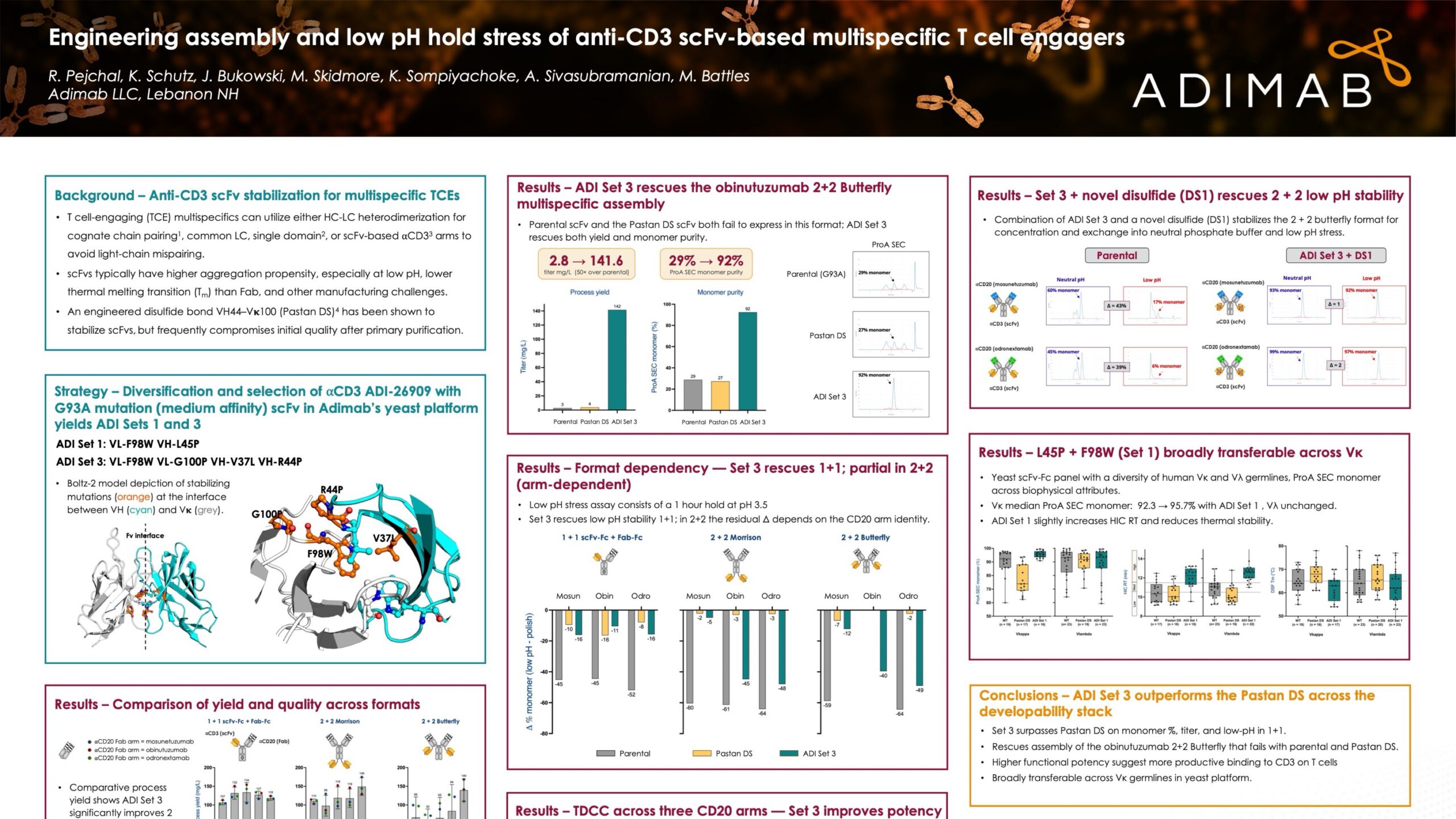
View poster