Kyle A. Barlow, Michael B. Battles, Michael E. Brown, Kaleigh Canfield, Xiaojun Lu, Heather Lynaugh, Morgan Morrill, C. Garrett Rappazzo, Saira P. Reyes, Chanita Sandberg, Beth Sharkey, Christin Strong, Jingfu Zhao, Arvind Sivasubramanian
March 24, 2025
Overview
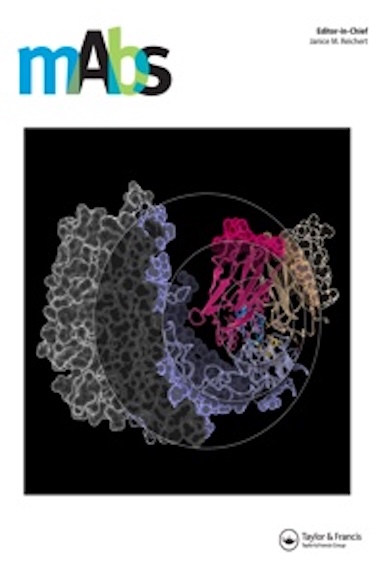
In this paper, Adimab scientists tackle a practical manufacturing problem for IgG-like bispecific antibodies (bsAbs): the mispairing of heavy chains (HCs) and light chains (LCs) in bsAbs with LCκs expressed from a single cell host, which results in heterogeneous mixtures with lower yield and purity. Using Rosetta to introduce novel hydrogen bond networks at the CH1:Cκ interface via computationally determined amino acid substitutions, the authors identified designs with enhanced pairing specificity and interface stability to create two complementary, orthogonal CH1:Cκ constant-domain interfaces. The final design, featuring a total of 11 amino acid substitutions across two Fab constant regions, was validated on a panel of bsAbs featuring a diverse set of unmodified human antibody variable domains. It showed near-complete elimination of LC mispairs while retaining the binding and developability properties of their monospecific counterparts. Furthermore, Fab crystal structures derived from these bsAbs revealed no major perturbations relative to the wild-type coordinates, and they confirmed the presence of the designed hydrogen bond interactions.
Key hypotheses and objectives
Our scientists hypothesized that introducing non-native hydrogen-bond networks in the constant domains of Fab regions could generate orthogonal sets of mutations with high predicted pairing specificity to prevent heavy and light chain mispairing without altering variable regions.
The objectives of the study were to:
- Design computationally optimized CH1:Cκ interfaces with enhanced pairing specificity.
- Validate that constant-domain–only modifications can enforce correct pairing across diverse antibody contexts.
- Confirm that these modifications do not compromise antigen binding, expression yield, biophysical stability or increase immunogenicity.
- Compare engineered designs against prior heavy/light pairing solutions used in approved bsAb products like emicizumab and faricimab.
Computational design and experimental approach
The team applied Rosetta’s Monte Carlo HBNet algorithm to redesign constant domain interfaces by introducing specific electrostatic and hydrogen bond networks. Mutations were scored using the flex ddG protocol, which evaluated the energetic gap between correctly paired and mispaired states as well as the subunit interface stability.
Two design configurations were modeled and tested:
- Single interface designs (SIDs): one Fab arm with a modified CH1:Cκ domain interface paired with a wild-type CH1:Cκ on the other Fab arm.
- Double interface designs (DIDs): both Fabs carrying independent engineered constant domains.
These data converged onto a pair of complementary CH1:Cκ interface redesigns (labeled 1443 and 1993) that led to the near-complete elimination of Fab mispairs, including in bsAbs with relatively high baseline levels of mispaired species in the context of WT Fab constant domains. Structural analysis confirmed that the sequences selected for experimental characterization covered diverse positions on the CH1:Cκ interface.
The selected mutation sets were experimentally validated using the variable regions from the therapeutic antibodies panitumumab (anti-EGFR) and ustekinumab (anti–IL-12/23). bsAb production was conducted using a plasmid ratio of 1:1:1:1 for the two HC and two LC chains. Each construct was analyzed for expression titer, purity, assembly accuracy (via LC-MS and cation exchange chromatography), binding kinetics (Biacore), developability (SEC, HIC, PSR), and in vitro immunogenicity risk.
Major findings and results
The 1443 and 1993 mutation sets designed using HBNet introduced a total of 11 amino acid substitutions within CH1:Cκ (eight of which were charged residues). Individually, each improved pairing efficiency; combined as the 1443/1993 DID across bsAb pairs drove near-100% correct pairing in at least one orientation. Notably, the design predicted by Rosetta to have the largest energetic gap between correctly paired and mispaired states, 1443/1993, is the same design that showed the best correct pairing experimentally. The 1443/1993 DID mutation set was further validated on additional variable domain combinations (ofatumumab, fresolimumab, necitumumab, and sifalimumab, targeting CD20, TGFβ, EGFR, and IFN-α, respectively).
Key experimental outcomes include:
- Nearly 100% correct heavy/light chain pairing across five IgG-like bispecific constructs incorporating six variable domains.
- Fab crystal structures (PDB: 9MFN, 9MI7) confirmed the presence of designed interchain hydrogen bonds and minimal backbone deviation (<0.5 Å RMSD) relative to wild-type counterparts.
- Favorable developability properties were maintained—SEC purity >95%, neutral hydrophobicity (HIC ≤10.5 min), and acceptable self-interaction scores in AC-SINS assays.
- No antigen-binding loss for engineered Fabs, verified through dual-antigen Biacore kinetics.
- No increase in immunogenicity risk—in vitro T-cell activation assays across 20 HLA-typed donors detected no enhanced cytokine or costimulatory receptor activation compared to controls.
Broader impact and engineering innovation
This work represents a constant-domain-only solution to one of the most critical challenges in bsAb generation—light chain mispairing in bsAbs that contain LCκ. Unlike previous designs (e.g., CrossMab or variable-region charge swaps), this approach leaves the variable regions untouched by simplifying the adaptation to independently discovered antibody pairs.
The computational pipeline combined de novo hydrogen-bond design via HBNet with multi-state energy optimization using flex ddG, which successfully predicted structures later confirmed experimentally. Our scientists’ observations demonstrated that charge complementarity and buried polar interactions, rather than hydrophobic packing, drive the selectivity of CH1:Cκ pairing.
Implications for therapeutic antibody development
- Manufacturing efficiency: The 1443/1993 mutation combination allows co-expression of multi-variable bsAbs in a single-cell host with negligible mispairing, accelerating development timelines.
- Platform generalizability: Demonstrated compatibility with diverse germlines and antigen targets indicates a plug-and-play backbone for next-generation bsAb discovery platforms.
- Regulatory and safety readiness: Immunogenicity profiling showed no adverse T-cell activation signatures, adding confidence for clinical translation.
- Structural blueprint: Crystal validation provides a mechanistic template for rational redesign of conserved protein interfaces, enabling broader use in therapeutic antibody scaffolds of hydrogen bond networks designed using Rosetta.
Ultimately, this study establishes a generalizable, empirically validated computational design strategy for achieving selective heavy/light chain pairing in IgG-like bsAbs. The orthogonal CH1:Cκ mutation sets 1443 and 1993 now constitute a foundational technology for next-generation bsAb manufacturing and design.
For more details, read the full article in mAbs.